
In the US, AI Regulation Is Increasingly Driven Not by Technology, but by Voter Pressure
Recent signals from the United States show that the pace of AI regulation is now being shaped not only by technological progress or safety arguments, but also by clearly rising public pressure and action from state-level politicians. This matters for Europe too: in the transatlantic AI market, rules will increasingly be shaped not just by the logic of innovation, but by political responses to voter fears about jobs, disinformation, and security.
Published: 8 June 2026
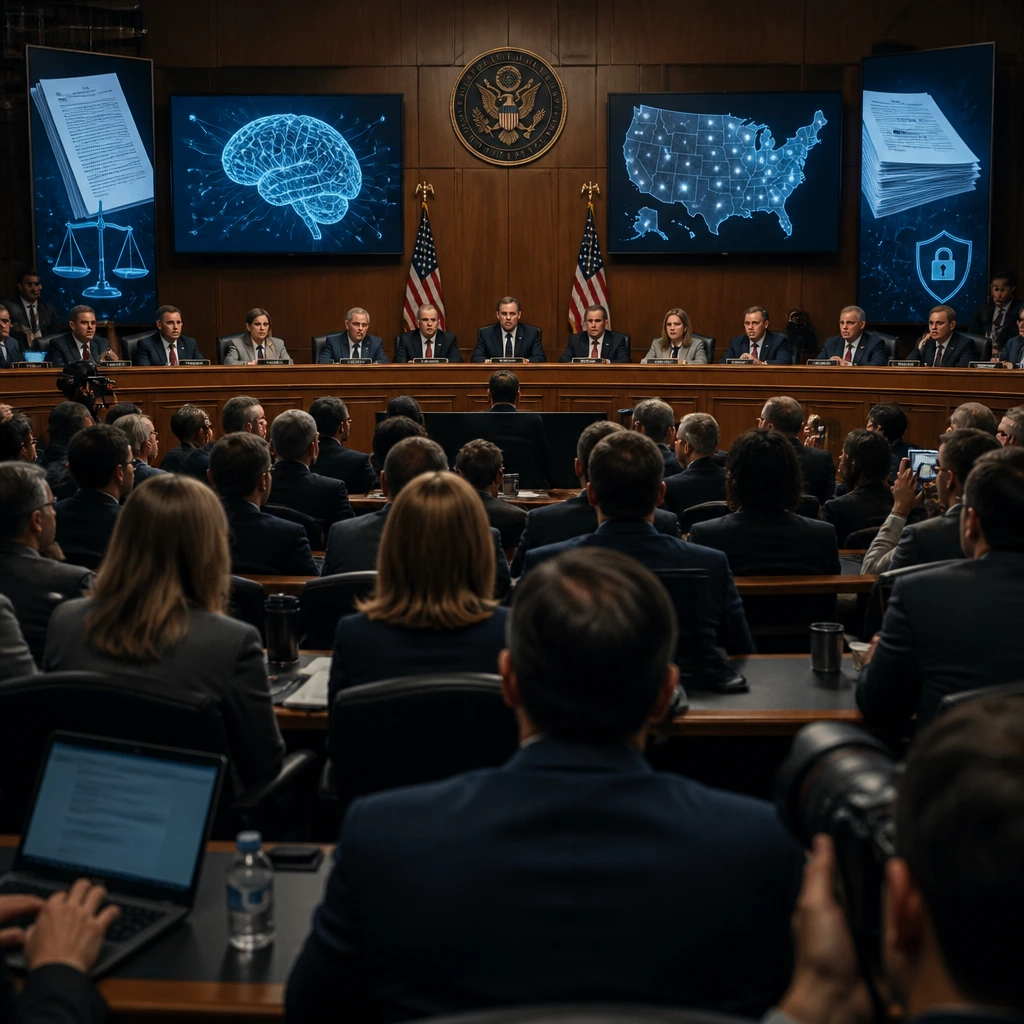
A new phase is emerging in US AI policy: the regulatory debate is being shaped less and less by Silicon Valley’s arguments about the speed of innovation, and more and more by voter sentiment, initiatives from state lawmakers, and fears that politics is lagging behind AI’s impact on the labor market, the information space, and public safety.
News from recent weeks confirms this on several levels. A Fox News poll showed that voters value safeguards more than the pace of innovation. Research from the Annenberg Public Policy Center found broad pessimism about AI’s impact and a belief that government has so far done too little. At the same time, California is considering new labor protections, Oklahoma and Ohio are looking at rules for political advertising and AI content labeling, and even bipartisan proposals in Congress are already triggering political controversy. In other words, AI regulation in the US is becoming not just a matter of technology policy, but of electoral politics as well.
From Federal Promises to State-Level Activism
One of the most important shifts is that regulatory initiatives are no longer coming only from Washington, but increasingly from the states as well. Oklahoma is examining AI use in political advertising, Ohio is considering mandatory labeling and bans related to identity impersonation, and California is discussing worker protections in response to AI-driven changes in employment. This reflects a familiar American pattern: when the federal level hesitates, states begin creating a fragmented regulatory map.
For businesses, this is not just a legal detail. Different requirements across different states mean higher compliance costs, more complicated product rollouts, and the need to build internal control mechanisms early. If an AI tool is used in hiring, customer service, advertising, or content generation, companies may need to adapt not to one national standard, but to several parallel sets of rules.
Voter Sentiment Is Becoming a Real Regulatory Force
Until now, much of the AI policy debate has been driven by expert arguments: model safety, national competitiveness, technological sovereignty. But polling shows that public opinion is becoming an independent force. When a majority of voters believe safeguards are more urgent than accelerating innovation, politicians gain a strong incentive to show they are taking action.
This is especially important in the run-up to elections or during periods of heightened public sensitivity to disinformation, automated fraud, and job loss. Politicians who previously spoke about a flexible approach to AI are now increasingly adopting tougher rhetoric. In other words, regulation is becoming not only a tool of precaution, but also a tool of political survival.
This shift also helps explain why AI debates are increasingly centered on specific issues voters can easily understand:
- can AI-generated fakes influence elections;
- will workers be laid off without any transition period;
- will children and consumers be protected from manipulative content;
- is the state in control of growing biological, cyber, and information risks.
Political Advertising and the Labor Market Are the Two Issues Most Likely to Accelerate New Rules
Of all the directions AI regulation could take, two appear politically strongest. The first is labeling for political advertising and synthetic content. Because this is directly tied to election integrity, rapid progress is likely in this area at both the state and federal levels. The second is labor market protection. California’s moves show that AI is no longer viewed only through the lens of productivity; it is increasingly seen as a matter of social policy.
This shift matters for another reason: these issues are easier to “sell” politically than abstract model governance. Voters can more easily understand a requirement to label an AI-generated campaign clip or an obligation for employers to assess the impact of automation than a debate about evaluation protocols for foundation models.
What This Means for Europe and Lithuania
Europe is often seen as the jurisdiction that regulates first, while the US is seen as the one that waits longer. But if US regulation starts being pushed not only by institutions, but also by voter pressure, the transatlantic gap may begin to narrow. This does not mean the US will copy the logic of the EU AI Act, but it does mean the traditional American “wait and see” stance is weakening.
For Lithuanian and European companies, this matters for three reasons. First, if a product is being built for the US market, EU compliance alone will no longer be enough — companies will also need to monitor state-level rules. Second, American partners may begin demanding more evidence of auditing, documentation, and risk assessment. Third, political pressure in the US may accelerate the emergence of shared norms around labeling, labor-market transparency, and safety controls.
For European companies, this could even become an advantage. Organizations that already maintain model risk registers, data provenance documentation, human oversight processes, and AI usage policies will be better prepared for requirements from both EU and US partners.
Practical Implications for Business: Prepare Not Only for Laws, but for Political Risk
The biggest mistake at this stage would be to treat AI regulation as a question only for lawyers. When rules are increasingly driven by voter sentiment, regulatory risk becomes reputational and commercial risk as well. A company may formally violate no law, yet still become a target of political or public pressure.
In practical terms, businesses should already:
- inventory where generative AI and automated decision-making are being used across the company;
- separate higher-risk use cases such as hiring, customer scoring, ad personalization, and public communications;
- put in place mechanisms for AI content labeling and human review;
- adopt a clear internal policy for informing employees when AI changes work processes;
- monitor not only federal US initiatives, but also the regulatory direction of major states.
In short, AI policy is now moving not only from the top down, but also from the bottom up. When voters begin to see AI as an urgent political issue, regulation gains a new kind of momentum. And that means that in both the US and Europe, the winners will be not only those building the most advanced models, but also those who adapt fastest to this new political reality.