
Washington’s Turn in AI Policy: From Free Markets to Strategic Control
Over just a few days, U.S. artificial intelligence policy has shown a clear shift: from declared deregulation toward a more active state role, stricter security requirements, and even possible government capital participation. For Europe and Lithuanian businesses, this signals that the AI market will increasingly be shaped not only by technology, but also by geopolitical decisions.
Published: 6 June 2026
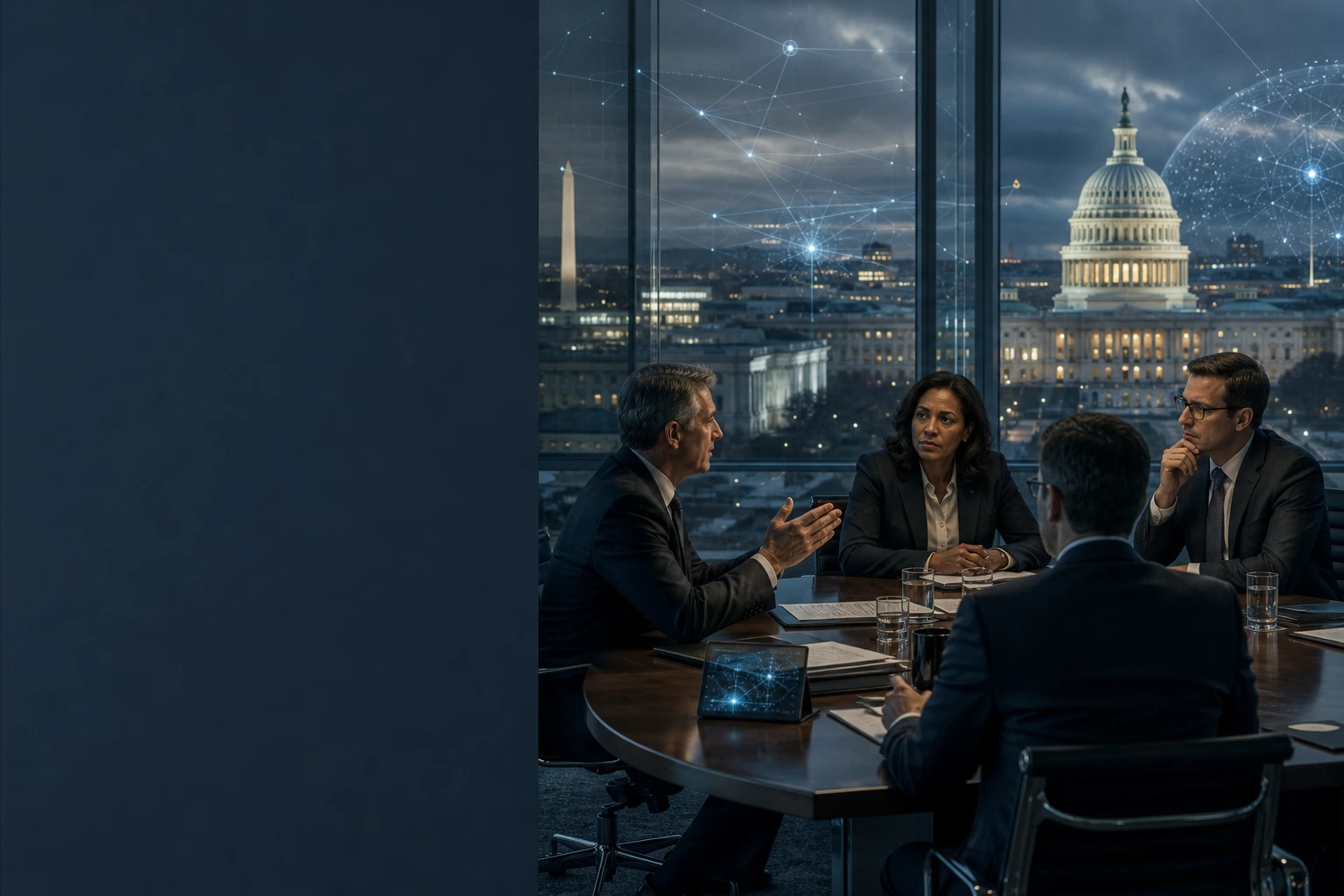
Recent news from the United States points not to isolated incidents, but to a broader political turning point in artificial intelligence. On one side, there are reports about possible U.S. government participation in OpenAI’s capital structure; on the other, there are public calls from AI company leaders for Congress to tighten biosafety controls, as well as disagreements between the White House and the technology companies themselves over AI safety rules. This means that AI policy in Washington is moving from abstract promises to concrete questions of power, access, and control.
Until now, the dominant narrative was that the U.S. would seek to limit innovation as little as possible, especially in competition with China. But the latest signals point to a more complex model: the state wants not only to encourage AI development, but also to exert more direct influence over who builds the most advanced models, what purposes they are used for, and which risks must be constrained in advance.
The State’s Role in the AI Market Is Becoming Direct
CNBC’s report on discussions between the Trump administration and OpenAI about a possible government stake in the company is politically significant not only because of OpenAI itself. It shows that the most advanced AI companies are increasingly being seen in Washington as strategic infrastructure rather than merely private startups.
This approach brings AI closer to sectors where state interest is considered legitimate and even necessary: defense, energy, semiconductors, and telecommunications. If the government begins to consider ownership, oversight, or special agreement models, that means AI is no longer just a market issue. It is now a matter of national power.
This shift is consistent with other signals coming from the U.S.: funding levels for AI infrastructure are growing, security agencies are directly using advanced models, and supply chains, chip access, and cloud computing capacity are becoming subjects of political decision-making. In other words, AI policy is beginning to look more like industrial policy.
Safety Is Returning to the U.S. Agenda Through the Door of National Security
The Fortune report on OpenAI, Anthropic, and Microsoft leaders urging Congress to regulate synthetic DNA sales shows an important change. In the U.S., AI safety is increasingly being framed not as an abstract ethical issue, but as a concrete question of biosafety and national risk.
This is politically convenient for both sides. Technology companies can propose narrow, specific, and favorable rules rather than face a broader and less predictable wave of regulation. Meanwhile, politicians can more easily justify intervention when the discussion involves bioweapons, cyber operations, or critical infrastructure, rather than general technology governance.
Politico’s report that OpenAI broke with the White House position on AI safety rules only confirms that the U.S. is entering a new phase: no longer a debate over whether to regulate, but over which regulatory model to choose and who will effectively shape it. That matters because market leaders are now trying not to avoid rules, but to actively design their architecture.
What This Means for Europe and in the Context of the AI Act
In Europe, it has often been said that the EU regulates while the U.S. innovates. But the latest U.S. dynamics narrow that divide. The difference is that Europe regulates mainly through a horizontal legal framework, while the U.S. is increasingly moving through strategic, sector-specific, and security-driven decisions.
The EU context also matters here: the European Commission is preparing guidance on the classification of high-risk systems under the AI Act, while discussions in Brussels increasingly revolve around technological sovereignty. This means both sides of the Atlantic are moving toward a shared conclusion: advanced AI cannot be left to self-regulation alone. But the instruments will differ.
The U.S. model may become more selective, focusing more on national security, defense, biological risk, and strategic companies. The EU model will remain more procedural and centered on compliance, risk assessment, and documentation. For European companies, this will mean dual pressure: they will have to comply with EU rules while also tracking political shifts in the U.S. if they work with American models, cloud services, or suppliers.
For Lithuanian Businesses, the Key Issue Is Not Geopolitics but Dependency Risk
For Lithuanian companies, these developments should not seem distant. Most organizations already use, or plan to use, models, APIs, cloud infrastructure, and productivity tools from U.S. companies. If the operation of these platforms is increasingly shaped by state interests, security restrictions, or export controls, businesses face a new kind of dependency.
The practical question is simple: does your AI strategy depend on a single supplier, a single model ecosystem hub, or a single jurisdiction? If so, political decisions may directly affect pricing, feature availability, data governance, or even whether certain use cases remain permitted.
Lithuanian businesses should consider several priorities:
- have more than one AI supplier for critical functions;
- separate low-risk and high-risk AI use cases;
- assess whether sensitive processes should run on European infrastructure;
- clearly define service continuity, data usage, and model change terms in contracts;
- monitor not only the AI Act, but also changes in U.S. security policy if the business depends on U.S. technologies.
The Center of AI Policy Is Now Not Only Regulation, but Power
The biggest lesson of the moment is that AI policy can no longer be reduced to the question of whether more rules will be needed. The real question is becoming this: who will control the most advanced models, computing infrastructure, data flows, and permissible use cases.
U.S. news about possible government participation in OpenAI, the security debate over biological threats, and rising tensions between government and AI companies show that a new regime is taking shape. In it, AI companies will be not only engines of innovation, but also strategic partners, objects of regulation, and instruments of geopolitical influence.
For Europe, this is both a warning and an opportunity. A warning, because the global AI market is becoming more politically fragmented. An opportunity, because the EU can position itself as a space where AI reliability, compliance, and infrastructure autonomy are not obstacles, but competitive advantages. For Lithuanian businesses, this leads to one clear conclusion: today, an AI strategy must be not only technological, but also geopolitical.