
A G7 Signal to the AI Market: Technology Leaders Are Already Sitting at the Geopolitical Table
With OpenAI, Anthropic, and Google executives joining heads of state at the G7 summit, AI companies are clearly moving beyond the role of technology vendors and becoming centers of geopolitical power. For Europe, this means not only a regulatory challenge, but also a need to reassess its dependence on a small number of U.S. model providers.
Published: 17 June 2026
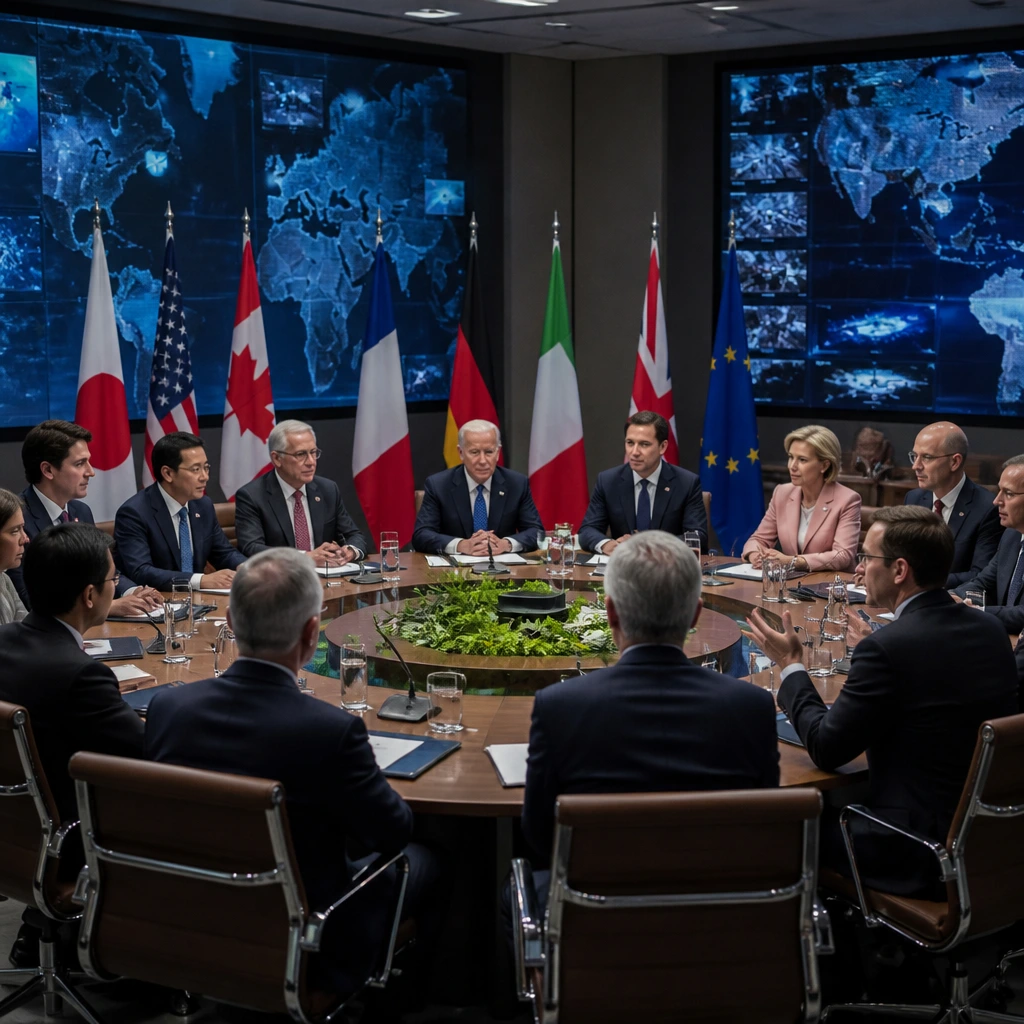
AI policy is entering a new phase. While major AI companies once operated primarily as technology builders, they are now increasingly becoming players in geopolitical power. This was especially evident at the G7 summit, where representatives from OpenAI, Anthropic, and Google took part alongside national leaders.
The very fact that developers of the most advanced models are being invited to top-level political forums is an important signal to the market. The question is no longer only about the pace of innovation or the balance of regulation. The question is about who controls access to the most advanced models, who can restrict their use across borders, and how businesses in Europe should prepare for a situation in which AI infrastructure becomes a strategic resource.
AI companies are shifting from vendors to strategic partners
The G7 format has traditionally focused on the economy, security, and the international order. That is why the presence of AI company leaders alongside heads of state is not just a public relations symbol, but a sign of changing status. Developers of frontier models are now seen not only as private market players, but as part of broader questions around infrastructure, security, and competitiveness.
This shift has several consequences. First, advanced models are increasingly being treated as a strategic capability, much like semiconductors, cloud computing, or cybersecurity. Second, government decisions may directly affect who gets access to specific AI systems, and under what conditions. Third, corporate leaders are gaining more political influence than traditional software vendors would normally have.
This development is also changing the logic of AI policy itself. What is being governed is no longer just harm or transparency, but also access, export controls, talent mobility, cloud resources, and restrictions justified by national security concerns.
The Anthropic case showed that access to models can be cut off for political reasons
Recent developments surrounding Anthropic reinforced this signal even further. Reports that the United States had instructed restrictions on access to certain advanced models for foreign entities showed that AI supply can be managed not only through commercial contracts, but also through geopolitical decisions. Even if the legal basis, scope, or implementation details remain unclear, the precedent itself is highly significant for the market.
For businesses, this means a simple but uncomfortable reality: critical AI capabilities may not always be a guaranteed service. If a model is considered sensitive from a security perspective, access to it may be changed faster than organizations can redesign processes, budgets, or customer commitments.
For Europe, this creates an additional risk. Many companies across the region are rapidly adopting models from U.S. providers for customer service, software development, analytics, or security automation. But if access to the most advanced systems starts to depend on export controls, political negotiations, or security reviews, what was once a technology choice will become a supply chain risk issue.
What this means for European policy and the AI Act context
In Europe, the AI debate has so far focused mainly on rules: risk classification, transparency, compliance, and liability. But the G7 and recent U.S. decisions show that regulatory architecture alone is not enough. Alongside legislation, the question of capability is becoming increasingly important: who in Europe actually controls models, compute infrastructure, data access, and deployment ecosystems.
That is why Europe’s strategy is likely to place greater emphasis not only on oversight, but also on technological sovereignty. This could mean more support for local model developers, stronger interest in open-source alternatives, additional public sector investment in compute capacity, and stricter evaluation of critical AI supply chains.
For Lithuania, this context is especially important. For smaller markets, it is not enough to simply wait for the rules to settle between Brussels and Washington. It is necessary to understand early on in which areas dependence on a single model provider is acceptable, and where it creates operational or legal risk.
Practical consequences for business: from a pricing issue to an availability issue
Until recently, most organizations chose AI providers based on model quality, price, speed, and ease of integration. Now those criteria need an additional layer: geopolitical availability. In other words, what matters is not only whether a model is the best today, but whether it will remain reliably available in six or twelve months.
Companies should review several practical questions:
- Do critical processes depend on a single U.S. model provider?
- Is there a technical ability to switch quickly to an alternative model?
- Do contracts clearly address the risks of service restrictions, access suspension, or regulatory change?
- Do the data and workflows in use allow a transition, if needed, to European or open-source solutions?
- Are the board and risk team already assessing AI supply as a strategic dependency rather than just an IT purchase?
This is especially relevant in finance, the public sector, cybersecurity, healthcare, and defense supply chains. In these areas, an advanced model can become not just a matter of productivity, but of business continuity.
A new logic of competition: the best models alone will not win
The G7 signals that the next phase of AI competition will not be decided in laboratories alone. The political dimension of trustworthiness will also matter: which companies can ensure stable availability across different markets, which can operate under different jurisdictions, and which have enough partners for their technology to be seen as a safe choice for governments and large enterprises.
As a result, several parallel movements may strengthen in the market. Some customers will concentrate even more heavily on major U.S. providers, because they have the greatest capabilities and political influence. Others, by contrast, will seek diversification: open-source models, European providers, or hybrid architectures that prevent their entire operation from being tied to a single geopolitical center.
In this context, Europe has an opportunity not only to regulate, but also to offer an alternative: a market in which reliability, compliance, and multi-vendor architecture become a competitive advantage. But achieving that will require faster decisions than legislation alone can deliver.
What to expect next
In the short term, the role of AI companies in top-level political forums is likely to continue growing. At the same time, discussions around model export controls, access restrictions, national security reviews, and special rules for the most advanced systems will increase. That means AI policy will become ever less separable from trade, defense, and foreign policy.
For European companies, the key conclusion is simple: an AI provider should be evaluated not only as a software partner, but also as a geopolitical risk factor. The G7 summit only confirmed this. When model developers are sitting at the table with world leaders, their products are no longer just products — they are becoming power infrastructure.